


JOS, NIGERIA — The future of Nigeria’s landscape restoration took center stage in Jos as key stakeholders gathered to review priority interventions on Day 5 of the implementation-focused engagement for 10 Strategic Catchment Management Plan (SCMP).
The high-level meeting focused on the Sarkin-Pawa-Kaduna Catchment—a vast 3.88-million-hectare ecological corridor with 35 LGA and 318 wards spanning six states: Kaduna, Niger, Katsina, Kano, Bauchi, and Plateau.
The catchment is currently bleeding from severe environmental degradation. At least 388,682 hectares—10% of the entire basin—across 293 political wards require urgent, large-scale intervention. The local government areas of Munya, Shiroro, Kauru, Kachia, and Chikun are the hardest hit, collectively accounting for 63% of all degraded land. Among the chief environmental threats, destructive flooding ravages 63.4% of the terrain, while soil erosion impacts 50.1%.
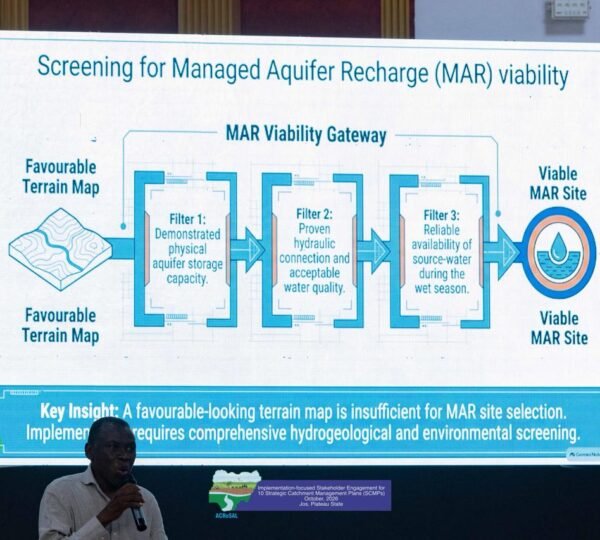 Despite the severe degradation, the region possesses immense hydrological potential. Presenting the Water Resources Assessment, Prof. Dibal of the University of Jos revealed that the basin receives an astonishing 58.7 billion cubic meters of rainwater annually, sitting mostly on a solid granite foundation that covers 60% to 65% of the landmass. Consequently, the core issue facing the basin is not water scarcity, but poor retention.
“The value of rain is not measured only by how much falls, but by how wisely the catchment returns, releases, and protects it,” Prof. Dibal emphasized. To prevent vital water resources from washing away, he strongly advocated for the construction of infiltration bays and the execution of a pilot groundwater recharge scheme in Kumadugu.
The workshop also delivered crucial operational directives by World Bank Environmental Specialist/Task Team Leader, ACReSAL, Dr. Iganya Joy Agene, FNMGS, who issued a strict zero-tolerance warning regarding child labor on World Bank projects. “No minors,” Dr. Agene stated firmly. “When you are less than eighteen, you cannot work on any World Bank-financed project. It is strictly against policy, and non-compliance can lead to project closure.”
 Turning to youth and gender dynamics, Dr. Agene struck a critical demographic chord. Highlighting that energetic and intelligent young people make up 60% to 70% of Nigeria’s population, she announced that the Agro-Climatic Resilience in Semi-Arid Landscapes (ACReSAL) Results Framework—under its Additional Financing—will now explicitly track youth beneficiaries, transforming them into environmental ambassadors.
Dr. Agene was equally decisive on female inclusion, asserting that the era of sidelining women is officially over. She revealed that ACReSAL maintains a 100% gender tag—a major corporate commitment that secures international donor financing. “ACReSAL has a hundred percent gender tag, and because of that, you receive specific support… we must ensure proper balance across all projects,” she warned.
On translating plans into reality, Dr. Agene stressed that success extends far beyond simply drafting the SCMP. True impact relies on swift implementation, securing strong legal backing, and establishing accepted national guidelines for catchment management planning scale—a framework Nigeria currently lacks.
She characterized the SCMP as a collective team effort spanning from local community women to Governors, the President, federal and state lawmakers, and civil society. While the initial eight management plans—now expanded to 20 by ACReSAL—were consultant-driven alongside 200 micro-catchment plans, the ultimate vision is localization. The goal is to empower a District Head to convene his community for local planning, down to individual farmers planning sustainably with their families.
Citing successful models in Ethiopia, India, and China, Dr. Agene noted that executing these plans effectively will earn Nigeria global recognition well beyond the ACReSAL project scope.
Underscoring the high stakes, ACReSAL National Project Coordinator, Abdulhamid Umar, disclosed that the project’s strong performance since 2021 has earned presidential approval for a major scale-up beyond the original $700 million allocation. He charged all stakeholders to take full ownership of the Strategic Catchment Management Plan. He noted that ACReSAL working with experts, academia, traditional institutions and local communities has a critical role to play in reversing degradation affecting over 43% of Nigeria landscape.
Umar closed his address with an emphatic call for long-term sustainability: “There is an urgent need to institutionalize everything we have accomplished to ensure these interventions outlast the project life cycle.”
 Providing a comprehensive diagnostic overview, Mr. Chuka Offodile, Managing Director of Mecon Geology and Engineering Services, detailed the multi-dimensional environmental and socio-economic challenges affecting the upper, middle, and lower zones of the catchment. These include severe gully erosion, flash flooding, deforestation, mining-related pollution, water scarcity, declining groundwater tables, poor sanitation, overgrazing, unsustainable fishing, and escalating conflicts over land and water resources.
To combat these threats, the proposed SCMP outlines a series of targeted physical and policy interventions: afforestation, hill terracing, check dams, stormwater drainage systems, riverbank stabilization, agroforestry, mining regulation and land rehabilitation, rainwater harvesting, urban drainage upgrades, climate-smart agriculture, irrigation expansion, grazing reserve management, waste facilities, sustainable fishing regulations, integrated watershed management, and community peace-building initiatives.
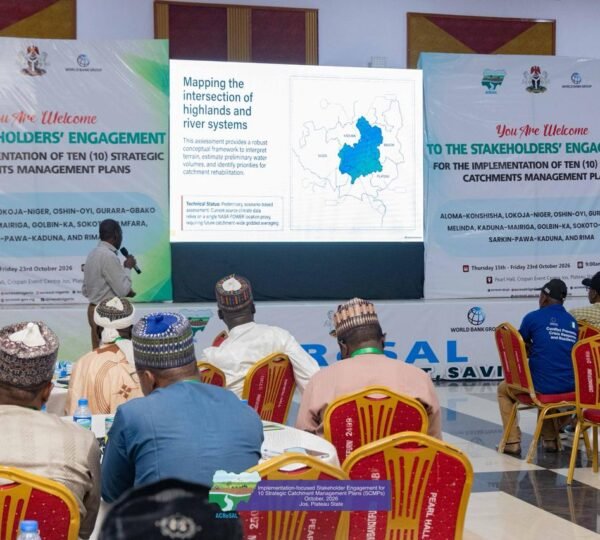 Additionally, technical insights were presented by Mr. Sam Oji from the National Center for Remote Sensing, who demonstrated the application of GIS-Based Multi-Criteria Decision Analysis (MCDA) to precisely identify and prioritize optimal intervention sites across the catchment.
During the interactive breakout sessions, stakeholders collectively agreed that these multi-sectoral interventions will dramatically boost regional water security, mitigate flood and erosion risks, restore fragile ecosystems, enhance agricultural yields, strengthen climate resilience, improve public health, and promote sustainable livelihoods and unified governance across all six participating states.